The Making of “Farm to Table”: Harvesting
As a Midwesterner I find myself a little starstruck when in the mountains, at the ocean or the desert, and it’s often to the detriment of the equally unique and beautiful character of the fruited plain where my roots run deep. When my son bought a house in farm country, he unwittingly opened up the opportunity for me to study the landscape in my own backyard. With my husband behind the wheel for the 60-minute drives I’m free to ride shotgun, taking it all in. Once we escape the urban sprawl of our day-to-day life, the trip becomes a meditation through pastures, crops, barns, silos and rambling old farmhouses.
After a few trips spent snapping unsatisfying photos of the scenery as we whizzed by and shooting slow motion videos with my arm out the car window, it became obvious that documenting with my mobile phone fails to give these wide-open spaces their due justice. I turned to my sketchbook and began filling pages with thumbnail drawings using a fat Sign Pen to harness the images we passed. As we watched the land cycle through the four seasons an idea began to germinate for a series about the heartland in all its beautiful flatness and unincumbered sky. I’ve never celebrated the Great Plains in any of my work.
When a concept takes hold, my process is simply to pick up the pen, draw, and keep drawing even if it feels like it’s the same handful of images over and over again. This repetition tells me what I find both compelling and abundant in the landscape. It begins to suggest the story of place while supplying multiple perspectives to consider when homing in on the select few compositions that will be promoted for further development.
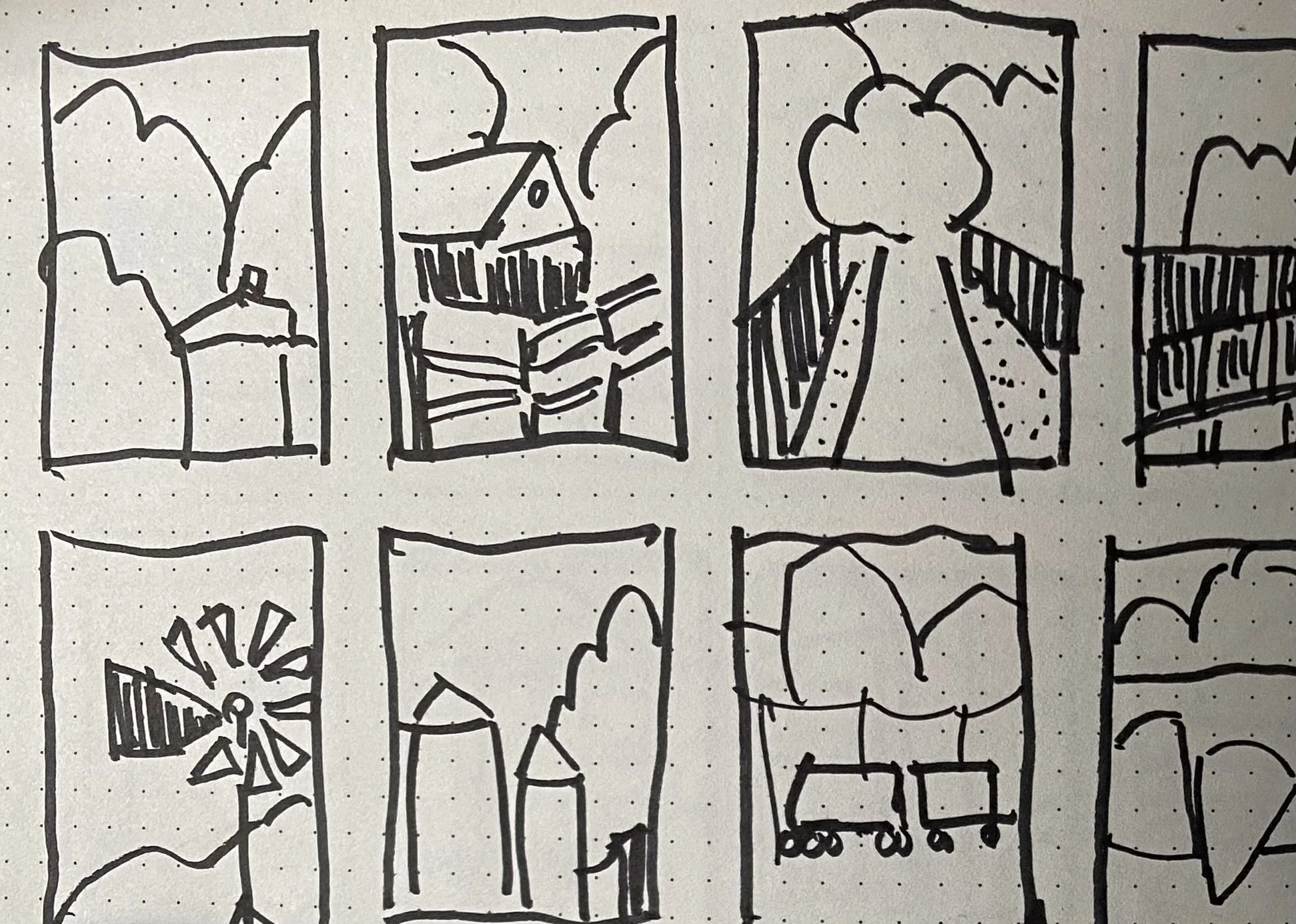
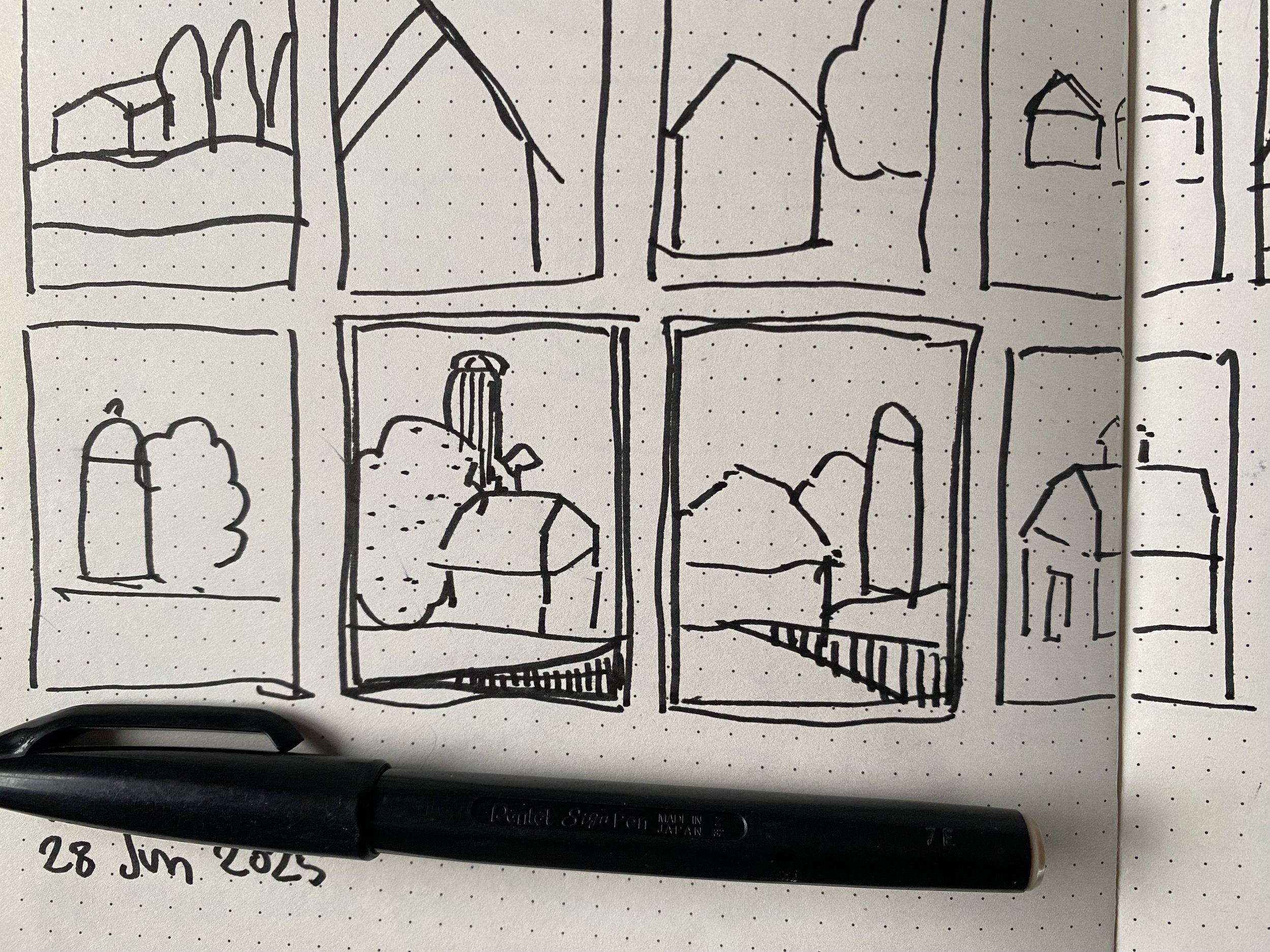
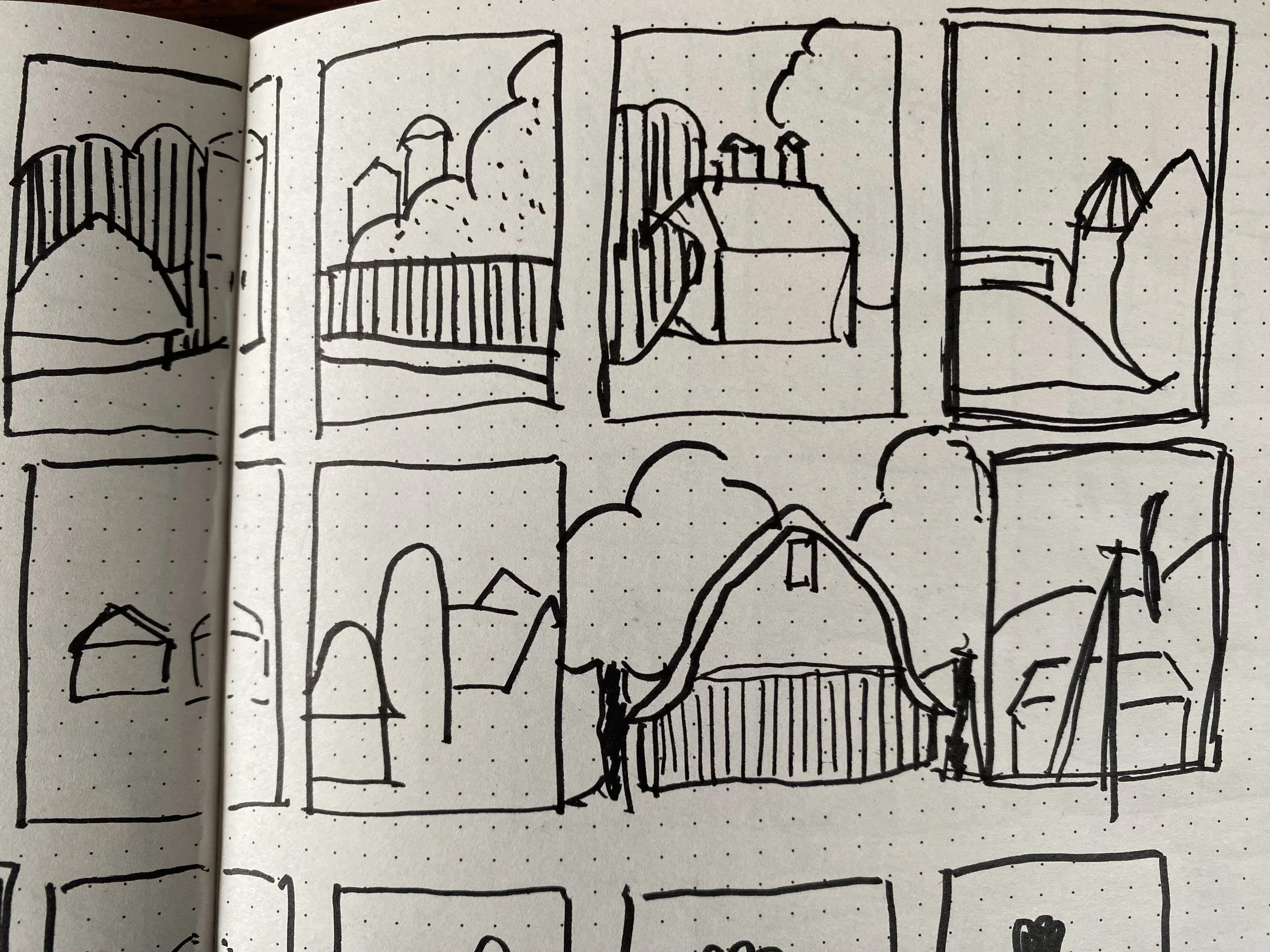
I’ve learned to accept imperfection, be okay with the misses that look nothing like what I’m trying to portray, to stop judging even the most ridiculous drawing blunders with such a critical eye. These timed drawings (seconds) are woefully underdeveloped and all about subtraction, hewing composition. The image I’m capturing is in the rearview mirror in the blink of an eye so I need to make snap decisions about what will be in the frame and how to keep it simple. By the time I’m ready for another look, the image is gone, leaving all kinds of space for my imagination to fill in. I get the main idea down, adding some hatching to differentiate shapes and suggest depth so when I pick up the sketchbook again, I can recall the subject.
The sketches that inform “Farm to Table” were made over several drives through the country and hours of studio time. The technical work with conveying this landscape is in capturing the depth of field, being able in the same frame to evoke the breadth and boundlessness of open fields while magnifying the iconic shapes that let the viewer know it’s a farm. I make more drawings in my sketchbook from the drawings in my sketchbook. I focus on refining the images I swoon over: The rooflines of bright red barns alongside hale metal silos, the patchwork fields of crop rotation, a windmill or meandering fence.
I love this stage of the process. It’s all about abundance. More is more, as one of my favorite painting instructors likes to say. And making more is the practice of art. It’s what takes us from wishing to be an artist to confidently calling ourselves artists. It’s a virtuous cycle, the more drawings I make the more I want to explore this landscape and the more I explore this landscape, the more drawings I want to make.
We truly fall in love with our work when we can render it as we imagine, to satisfy our own eyes before ever dreaming of satisfying a viewer’s eyes. When I think about the Great Plains now, it’s with as much reverence as any other place I’ve traveled to. There is beauty in those places familiar and easily accessible to us. Sometimes it takes a sketchbook and a pen to unearth it.